
Why people switch phone carriers (and why your next one should earn you)
Nobody switches phone carriers for fun. Most people put up with a so-so plan for months, sometimes years, until one thing tips the scale: a dropped call at the worst moment, a bill that crept up again, or a friend who pays half as much for the same thing.
Still, more of us are paying attention than you might think. According to OXIO’s 2026 Mobile Consumer Survey, 70% of consumers reassess their phone plans at least once a year, and Gen Z is even more discerning, examining their plans at least every six months, with some checking quarterly for a better deal elsewhere.
Reviewing your plan vs. actually leaving?
The American Customer Satisfaction Index found that big carriers still hold on to customers slightly better than smaller ones, and it points to reasons like brand familiarity, bundles, switching friction, and the inertia that often governs household service decisions. In other words, plenty of people stay not because they’re happy, but because leaving feels like a hassle.
What pushes people to make the move?
We didn’t want to guess, so we asked. The answers fall into a handful of familiar categories, and here they are, along with our not-so-secret mission: making sure you never have a reason to pick any of them.
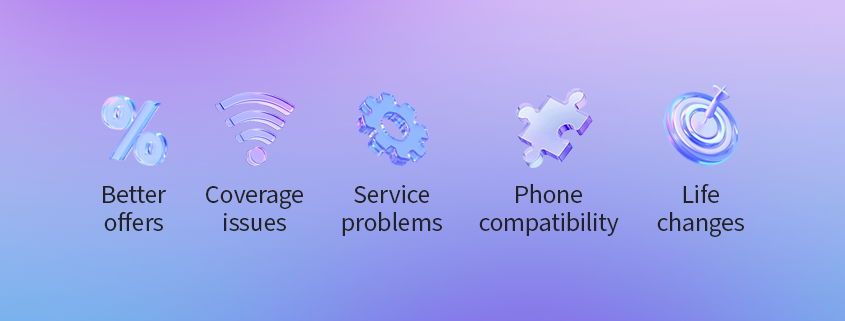
1. Better offers
This is the most common and most honest reason. Somewhere out there, a plan with more data, a lower price, or fewer strings attached caught your eye, and suddenly your current phone bill looked a lot less reasonable.
Wanting a better deal is smart shopping. Just compare the full picture, not only the headline price. Check whether taxes and fees are included, whether the price goes up after a promo period, and whether you’re locked into a contract or device payments.
💙 With Tello, there are no contracts or lock-ins because life changes and your phone plan should be able to keep up. So change your plan whenever you want, whether your data needs are higher or lower, your budget shifts, or life simply looks different.
2. Coverage issues
You may know the routine: walking to the one corner of the kitchen where the signal works, or holding your phone up like it’s searching for a message from space. If your carrier doesn’t cover the places you spend your time, the price hardly matters.
Before you switch, check the new carrier’s coverage map for the addresses that matter most: home, work, your commute, and anywhere you visit often. Many smaller carriers run on the same networks as the big names, so better coverage doesn’t have to mean a bigger bill.
💙 Tello runs on America’s largest 5G network, so you get reliable coverage without paying the premium price tag. You can check the coverage and signal strength in your area using Tello’s coverage map. This can help you see what kind of coverage to expect at home and other places you visit regularly.
3. Service not working
This one is different from coverage. Coverage is about where your phone works. Service problems are about whether it works. That can mean data that crawls even with full bars, activation that never quite finishes, or billing and account issues that take ages to sort out.
One bad day happens with any provider. A pattern is a different story. If you’ve been troubleshooting the same problem for weeks, it’s fair to decide your time is worth more than that.
4. My phone isn’t compatible
Sometimes the switch happens because of the phone rather than the plan. The most frequent scenario: you move to a new carrier and discover your current phone isn’t compatible with its network.
The fix is to check compatibility first. Most carriers, including Tello, let you enter your phone’s details or IMEI number to see if it will work. Also make sure your phone is unlocked. A locked phone is tied to its original carrier, and that can stop a switch before it starts.
5. Others
This covers moving to a new city, splitting from a family plan, getting a company plan or getting tired of a carrier for reasons that are hard to name. Life changes, and your phone plan doesn’t always change with it. If your plan was chosen for a version of your life that no longer exists, it’s worth a second look.
Before you switch: a quick checklist
Whatever your reason, a few steps make the move painless:
- Keep your number. You can usually bring your current number to a new carrier by porting it.
- Don’t cancel your old service first. Start the switch with the new carrier and let the port go through. If you cancel first, you risk losing your number.
- Unlock your phone and confirm it’s compatible with the new network.
- Have your account details ready. You’ll typically need your old account number and a transfer or port-out PIN from your current carrier.
- Compare the total cost. Include fees, taxes, and any promo periods.
The bottom line
Most people don’t leave a carrier on a whim. They leave because something stopped working, whether that’s the price, the signal, the service, or simply the fit. Curious what you’d pay with Tello? Check your coverage and build a plan in a couple of minutes.
Frequently Asked Questions
Can I keep my phone number when I switch?
Yes. You can transfer your existing number to Tello. See our guide to find out how.
Should I cancel my old plan before switching?
No. Start the switch with your new carrier first and let your number transfer. Cancelling first could mean losing your number.
Can I bring my current phone to Tello?
Yes, as long as it’s compatible and unlocked. Tello supports both SIM and eSIM. Check your phone’s compatibility here.
Will I get good coverage with Tello?
Tello runs on America’s largest 5G network. Check the coverage map for the places you go most.
Are there contracts with Tello?
No contracts, no lock-ins. You can upgrade or downgrade your plan free of charge anytime.
How much does a Tello plan cost?
Talk & text starts at $5/month, data plans at $8/month, and Unlimited is $25/month with 50 GB of high-speed data and 10 GB of hotspot. See all Tello plans.

Leave a Reply
Want to join the discussion?Feel free to contribute!