
How Wi-Fi changed the way we use mobile data
Remember when you had to ration mobile data? Maybe you saved videos for later, switched off app updates, or did quick mental math before opening anything with autoplay. Somewhere around the middle of the month, you started treating every megabyte like the last cookie in the jar. And then came the text: “You’ve used 80% of your data.” Nothing ruins a bus ride quite like it.
Then unlimited plans arrived, and it seemed like those days were gone for good. Data became something you didn’t have to think about. Stream, scroll, download, repeat.
Your phone loves Wi-Fi. Does your phone plan know?
Here’s the funny part: While the wireless industry (yes, we’re part of it) was busy selling bigger and bigger data plans, your phone quietly found another way to get online. It moved in with Wi-Fi.
It didn’t happen overnight. Wi-Fi went from a nice extra at the corner café to something we expect everywhere: at home, at work, at the gym, at the dentist’s office, on some trains and planes, and in pretty much every place with a chair and a power outlet. Asking “what’s the Wi-Fi password?” became as normal as asking where the bathroom is. And our phones, being the practical little devices they are, started picking Wi-Fi whenever they could.
That shift changed more than how we get online. It changed how much mobile data most of us actually need, and that isn’t always what our phone plans assume. So let’s look at where your data really goes, who genuinely needs a lot of it, and how to tell which group you’re in.
Your phone is a homebody
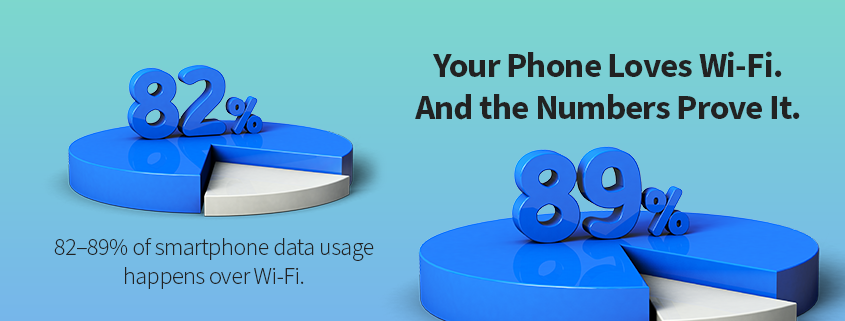
When OpenSignal studied how Americans actually use their smartphones in 2024, it found that between 82% and 89% of data usage happens over Wi-Fi rather than mobile networks, and that was true across all providers it analyzed.
That makes sense once you think about where you actually use your phone. People spend about three times more screen time at home than away from home. The couch, the kitchen table, and the “just five more minutes” in bed all happen within range of the router.
And the habit doesn’t stop at the front door. Offices, cafés, gyms, airports, libraries, and your in-laws’ living room all have a network name and, usually, a password on a sticky note somewhere. Your phone remembers every one of them and connects the moment you walk in.
The heavy lifting happens on Wi-Fi
There’s also a pattern in what people do on each connection. Even with unlimited plans widely available, people still tend to save data-heavy tasks for Wi-Fi.
Think about the biggest data users on your phone. System updates, photo backups, app downloads, and binge-watching mostly happen at home, often automatically, because phones are built to prefer Wi-Fi for exactly these jobs. By the time you head out, the heavy lifting is usually done. What’s left for mobile data is messages, maps, music, email, and a little scrolling while you wait for your coffee.
So who actually needs a lot of mobile data?
Some people really do. If you stream shows on your daily train commute, drive for a rideshare or delivery app, use your phone as a hotspot for your laptop, or don’t have home internet at all, mobile data is doing serious work for you. An unlimited plan can make perfect sense, and yes, we have one of those too.
But heavy users tend to be a minority. In one network sample from Ericsson, the top 10% of subscribers accounted for 65% of all traffic. That snapshot comes from Europe, but the pattern is a familiar one: a small group uses a lot, and most people use far less than they think.
So the real question isn’t whether unlimited data is good. It’s whether you’re paying for data you actually use, or for data that mostly sits there as a safety blanket.
Find your real number
You don’t have to guess, because your phone keeps score.
🔹 On an iPhone, go to Settings, then Cellular (or Mobile Data), to see how much you’ve used in the current period.
🔹 On Android, look under Settings, then Network & Internet or Connections, then Data Usage. Menu names vary a little by phone. If you can, check a few months, because one road trip can make a single month look unusual.
If your number regularly lands in the single digits, you may be paying for a lot of data you never touch.
Why we built our plans this way
This is exactly why we let you build your own plan. At Tello, plans start at $5 a month, so you choose the amount of data that matches how you really use your phone. If you live mostly on Wi-Fi, a mid-sized option like 10 GB for $15 a month may be all you need. If you’re in the heavy-user group, Tello’s Unlimited Plan is only $25 a month. Plus, there’s no contract, so you can change your plan anytime your habits change.
And since your phone spends so much time on Wi-Fi anyway, we let it do more than stream. Wi-Fi calling is included with Tello, so you can make calls over Wi-Fi when the cellular signal is weak. The basement apartment, the office with suspiciously thick walls, and the one room in your parents’ house where bars go to disappear all become fair game.
The bottom line
Wi-Fi didn’t make mobile data unimportant. It made it personal. For some people, cellular data is the main way they get online. For many others, it covers the in-between moments: the commute, the errand, the walk from one Wi-Fi network to the next. Knowing which group you’re in is the easiest way to stop overpaying.
Curious what your plan would look like? Check your data usage, then build a plan that fits it in a couple of minutes at Tello.com.
Frequently Asked Questions
Does using Wi-Fi count toward my mobile data?
Nope! When you’re connected to Wi-Fi, your internet activity generally doesn’t use your mobile data allowance. That means you can stream, scroll, and download without worrying about eating into your phone plan’s data.
How much mobile data do I actually need?
It depends on how you use your phone when you’re away from Wi-Fi. If you mostly send messages, check emails, and use maps, a smaller data plan might be enough. If you regularly stream videos, play online games, or use your phone as a hotspot, you’ll probably need more. Check your usage over a few months to find your sweet spot.
Want to dig a little deeper? Check out our blog post on how much data your everyday activities actually use.
Can I use my phone without mobile data if I have Wi-Fi?
Absolutely! You can browse the internet, use social media, stream videos, and send messages through internet-based apps over Wi-Fi. With Tello’s Wi-Fi Calling feature, you can also make and receive regular calls and texts over Wi-Fi when cellular coverage is limited, provided your device supports the feature and it’s properly configured.
Does Wi-Fi Calling use my mobile data?
No. Wi-Fi Calling uses your Wi-Fi connection rather than your cellular data allowance. It’s especially handy in places where your cellular signal isn’t at its best.
Is an unlimited data plan worth it if I use Wi-Fi most of the time?
Not necessarily. If you’re connected to Wi-Fi for most of the day and rarely use much cellular data, you could save money with a smaller plan. But if you travel frequently, stream on the go, or rely on your phone for work, unlimited data might still be your best bet.
Can I change my Tello data plan if my usage changes?
Of course! Tello plans come with no contracts or lock-ins, so you can upgrade or downgrade your data allowance whenever you need to, at no extra charge for making the change. More data for a busy month? Less when you’re spending most of your time on Wi-Fi? You’re in control.

Leave a Reply
Want to join the discussion?Feel free to contribute!